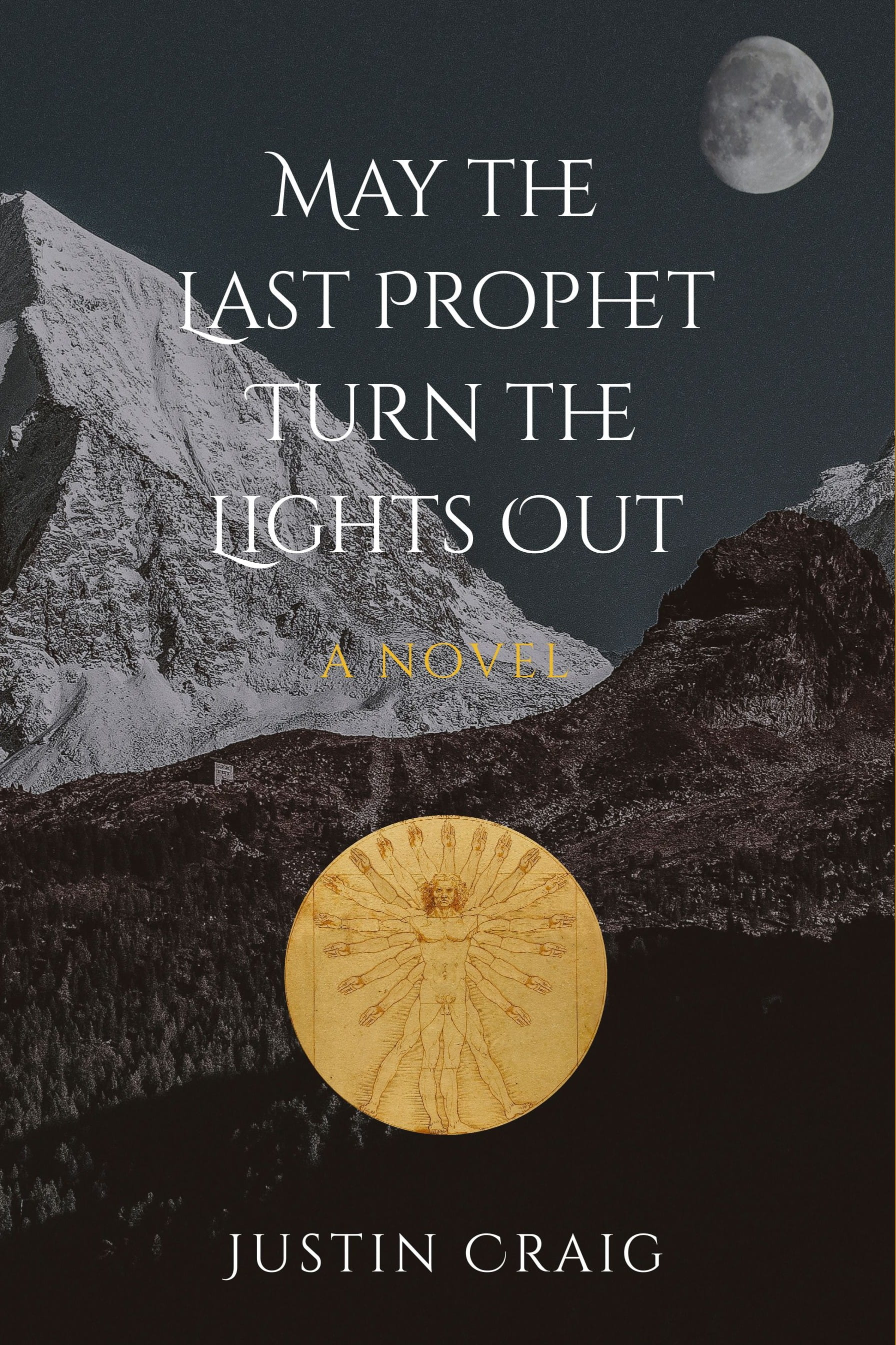
A mythic novel about the threshold between the dying world and the new.
May the Last Prophet
Turn the Lights Out
A Novel
A lightning strike. A strange anointment. A dying father who wants his son to "save my death." From apocalyptic visions as children in New Zealand at the bottom of the world, to the streets of San Miguel de Allende, to the guardian of a dead empire in Peru, May the Last Prophet Turn the Lights Out is a novel about what happens when the end of the world fails to live up to expectations.
1980, Christchurch. It is one in the morning when Daniel and his younger sister Tess confront a Hungarian farmer about their mother's disappearance. The old man had been struck by lightning twice, cross-wiring the circuits of his mind. What he tells the children sets in motion the unraveling of their father's first big lie.
But while Daniel opens his vision up, Tess shuts hers down. Daniel goes looking for the lie anyway, through a French counsellor who smokes at the window, a preacher whose name means Thunder, and an ancestor lost to a memory hole, toward a third strike that has his name on it.
Justin Craig's first novel, fourteen years in the making, in four directions: South, West, North, East.
With his head in the clouds, László's feet were anchored to a physical fate a hundred yards below and not even his prescient blending of the senses gave him forewarning. Then the wind contrived to suck instead of blow before swallowing the world in one giant gulp. Stepped leaders, the veiny sub-branches of negative charge, probed downwards for the path of least resistance. This time, the old man didn't receive the secondary anointment of an indirect strike. From the outside, a swarm of sparks flew off his extremities. For a moment, László was transfigured in a billion points of fire. In synchrony, my lower body began to convulse, and my hands flew up to orchestrate electrical light, pulse it through the channels and meridians of my body, so the shake-off of cellular debris―the corpus of belief housed in the body―didn't panic me into psychic split. Dispossessed of these bodily death throes, I was transported to a pure white sound stage with strobing disco lights, an ad-hoc theater of the absurd inside the lightning strike.
Giant hands refashioned László into a lifesized voodoo doll. Leg stitched to hip, shoulder plugged into socket, skull twisted into place. The placement of the head was the most ostentatious. There was a point being made—by whom? The puppeteer?—about the mind and its self-importance. The old man, newly formed arms and legs akimbo, began rotating, like Da Vinci's Vitruvian Man stuck inside a tractor tire rolling downhill.
Every rotation represented another generation copy of László, each more corrupted than the last on the road to entropy. The disco ball fell from the ceiling, toppling human bowling pins, each strike setting off a siren. The vision was practically begging the dreamer—me!—to notice the warping of the edges, the fake set, the barely concealed puppet strings, the ventriloquist mask muttering occult nonsense. Every level of descent inside the play of carnival mirrors, each generation of 'László,' only compounded my confusion.
My thoughts buzzed with mental static, racing to a conclusion I did not want to face, before circling back around and beginning again. "You have to take the hit if you want to become a sovereign man, a true man, a free man!" László shouted above the din. "A son of God!" The crackling was followed by a cymbal clash that ended the cacophony. The resulting silence hurt my bones. It was a nuclear drum vibrating through every cell of László's body, and therefore mine, filling us with atomic noise. "Re-member," László punned, "otherwise it all ends in a whimper not a bang." After a comic pause, lightning struck like a joke that had fallen flat.
When I regained my bearings, László was still sitting opposite me with his eyes closed, but occupying the whole room. I realized he spent most of his days and nights like this, exploring the untold things of Heaven and Earth without the dead weights of identity and desire. My body was still faintly vibrating, head to toe.
"You need to get this child's business out of the way," he said out loud.
"Reconciling with my mother?"
"You must hate your mother and father."
It was an instruction. But all László meant was the tethers they represented. In the simulacra of generational patterns, without renouncing my lesser genealogy, I would be reduced to a copy of a lost original. But if I dared to source from my original template, the matrices of belief would become more and more exposed. And like any failing empire, its degeneracy, its corrupted symbols and archetypes, would all bloom in garish spectacle before it collapsed.
"That's the risk," he said. "You need the third strike to end it all."